
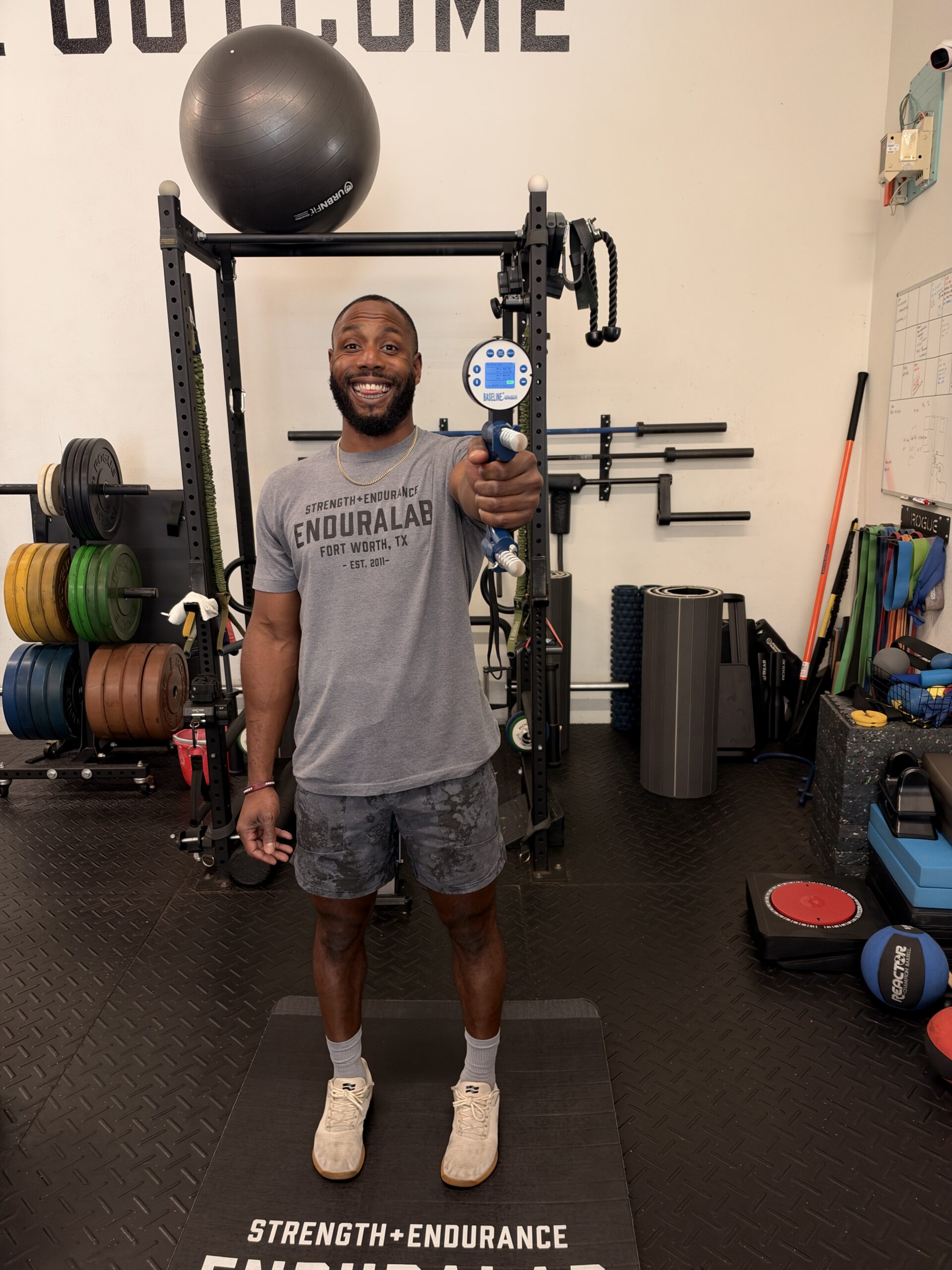
What if one of the most revealing measurements of your overall health had nothing to do with your weight, body fat percentage, or how much you can bench press?
It might come down to how hard you can squeeze your hand.
Grip strength has become an increasingly valuable marker of health and longevity. Research has linked stronger grip strength to lower risks of cardiovascular disease, cognitive decline, physical disability, and premature death. It can also provide insight into muscle function, frailty, nutritional status, and our ability to remain independent as we age.
At enduraLAB, we measure grip strength during our athlete assessments using a hand dynamometer. It’s a simple test that takes only a few seconds, yet it can tell us quite a bit about an athlete’s overall strength and physical capacity.
Strength Doesn’t Always Look the Way You Expect
One of the most interesting things we’ve observed while testing athletes is that physical appearance doesn’t always predict grip strength.
We’ve tested large, muscular athletes whose grip strength was surprisingly low. We’ve also tested smaller, leaner athletes, including some of our youth athletes, who produce impressive numbers on the dynamometer.
It’s a great reminder that looking strong and being strong aren’t necessarily the same thing.
Grip strength depends on more than muscle size. Neuromuscular coordination, training history, hand size, and the ability to recruit muscle fibers all influence how much force someone can produce.
An athlete who regularly carries heavy objects, climbs, hangs, or lifts without relying on straps may develop exceptional grip strength without having particularly large forearms.
This is one reason we value objective testing. Measurements can reveal strengths and weaknesses that aren’t always visible.
Why Grip Strength Matters Beyond the Gym
Researchers have studied grip strength extensively because it provides a practical snapshot of muscular function and overall health.
A large systematic review published in the British Journal of Sports Medicine found that adults with higher grip strength had lower risks of several long-term health conditions, including cardiovascular disease, type 2 diabetes, physical disability, cognitive decline, and dementia.
Grip strength has also been studied in relation to several important aspects of healthy aging:
- Longevity: Lower grip strength is associated with an increased risk of premature mortality.
- Brain health: Weaker grip strength has been linked to greater risks of cognitive decline and dementia.
- Frailty and independence: Declining strength can signal reductions in physical function and the ability to perform everyday tasks.
- Fall risk and bone health: Grip strength can help researchers assess broader musculoskeletal health, although balance, lower-body strength, and bone density require additional evaluation.
- Nutritional health: Low grip strength can be one indicator of reduced muscle function associated with malnutrition or inadequate nutritional intake.
These relationships are important, but they don’t mean that improving your grip alone will prevent dementia, fractures, or cardiovascular disease. Grip strength is best understood as an indicator of broader muscular and physiological health.
The takeaway is that the strength we build today can tell us something meaningful about our capacity to function tomorrow.
How We Train Grip Strength at enduraLAB
The good news is that grip strength is trainable, and you don’t necessarily need a specialized grip-strength routine to improve it.
Many of the movements we already incorporate into our programming challenge the hands, wrists, forearms, and supporting musculature.
Loaded carries are one of our favorites. Whether you’re performing a farmer’s carry with two heavy dumbbells or a suitcase carry with one, you’re developing grip endurance while strengthening your core and improving stability.
Dead hangs challenge your ability to support your body weight while developing grip endurance and shoulder control. Even short, controlled hangs can be challenging, and assisted variations make them accessible to more athletes.
Deadlifts require you to maintain a secure grip while producing force through your entire body. As loading increases, grip strength can become a limiting factor, which makes it an important component of overall lifting performance.
Pull-ups, rows, kettlebell movements, and other exercises involving sustained holds also contribute to grip development.
The goal isn’t to exhaust your forearms every workout. It’s to consistently expose your grip to appropriate challenges as part of a balanced strength-training program.
Train for the Strength You’ll Need Later
Think about how often grip strength shows up in everyday life. Carrying groceries, lifting luggage, opening containers, moving furniture, holding onto a railing, or picking up a grandchild all require some combination of hand strength and whole-body function.
These tasks may seem insignificant when we’re younger. As we age, maintaining the strength to perform them confidently becomes an important part of independence.
At enduraLAB, we believe strength training is about much more than building muscle or improving performance in the gym. It’s about developing the physical capacity to continue doing the things you love for as long as possible.
Grip strength is just one measurement in that bigger picture, but it’s one worth paying attention to.
The next time you pick up a heavy pair of dumbbells, hold onto a pull-up bar, or finish a challenging set of deadlifts, remember that you’re training more than your hands.
You’re building strength for life.
Interested in learning more about your strength, movement, and long-term health? Our athlete assessments at enduraLAB help identify where you are today and where you have opportunities to improve.

