You probably know how much weight you can deadlift, how fast you can run a mile, or how long you can hold a plank. Do you know how efficiently you breathe?
Breathing is something we do roughly 20,000 times a day without much thought. It is also something we can assess, practice, and improve.
At enduraLAB in Fort Worth, we believe a complete athlete assessment should look beyond strength, mobility, and cardiovascular fitness. That is why we include the Body Oxygen Level Test (BOLT) in our Performance Assessments. It takes less than a minute to perform, requires no equipment beyond a timer, and gives our coaches another piece of information about how an athlete responds to respiratory stress.
What Is the BOLT Test?
The BOLT test is a simple, controlled breath-hold assessment developed through the Oxygen Advantage breathing method. It measures the number of seconds between a normal exhalation and the first noticeable urge to breathe.
Despite its name, the BOLT test does not measure oxygen levels in your blood. Instead, it provides an indirect look at your sensitivity to the signals that drive breathing, particularly rising carbon dioxide (CO₂).
Carbon dioxide is often misunderstood as something our bodies simply need to eliminate. In reality, CO₂ plays an important role in regulating breathing and maintaining the conditions that allow oxygen to be released to our tissues.
As carbon dioxide accumulates during a breath hold, the brain receives signals that it is time to breathe again. The BOLT test helps us observe how quickly that urge develops.
How We Administer the BOLT Test
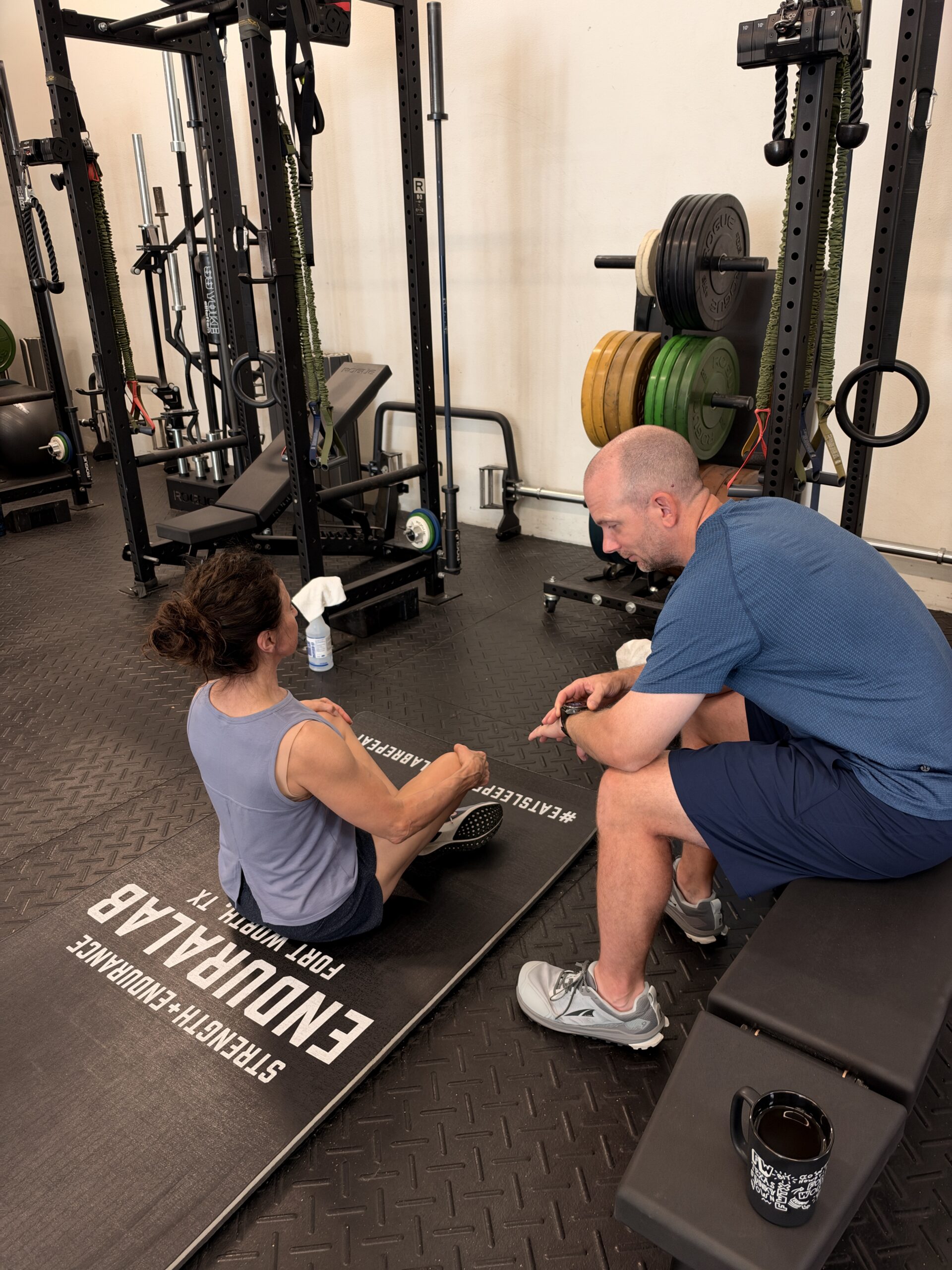
During an enduraLAB assessment, our coaches guide athletes through a simple process while they are rested.
- Sit comfortably and breathe normally through your nose.
- Take a normal inhale, followed by a relaxed exhale.
- At the end of the exhale, pinch your nose and begin holding your breath.
- Stop at the first definite urge to breathe, not when you absolutely cannot hold any longer.
- Release your nose, resume normal breathing, and record your time in seconds.
The important distinction is that this is not a competition to see how long you can hold your breath. If you finish gasping for air, you have held too long.
We want to observe your natural respiratory response, not your ability to tolerate an uncomfortable maximum effort.
What Does Your BOLT Score Mean?
BOLT scores are measured in seconds. The Oxygen Advantage method uses the following general benchmarks:
| BOLT Score | General Interpretation |
|---|---|
| Below 10 seconds | Very early urge to breathe; significant room for improvement |
| 10–20 seconds | Developing breath-hold tolerance |
| 20–30 seconds | Moderate to good tolerance |
| 30–40 seconds | Higher tolerance to the sensation of air hunger |
| 40+ seconds | Advanced benchmark in the Oxygen Advantage method |
These are training reference ranges, not medical cutoffs. A higher score does not automatically mean an athlete has better cardiovascular fitness, greater lung capacity, or a higher VO₂ max.
A strong, well-conditioned athlete may have a surprisingly low BOLT score. Someone newer to strength training may demonstrate a considerably higher one.
This is precisely why we assess rather than assume.
Why Breathing Matters at enduraLAB
Our Performance Assessments look at five areas: mobility, movement control, trunk capacity, strength and power, and respiratory capacity.
The BOLT test contributes to our understanding of that final category.
Breathing is involved in nearly everything we do in the gym. It helps us manage effort during conditioning, coordinate movement under load, and return toward a resting state between efforts.
Consider an athlete performing repeated intervals on the SkiErg. Their ability to deliver oxygen, manage ventilation, and recover between efforts all contribute to their performance.
Now consider a heavy squat or loaded carry. The athlete must coordinate their diaphragm, abdominal muscles, and trunk to generate stability while managing their breathing.
These are different demands, yet both require a respiratory system that responds appropriately to the task.
The BOLT score alone cannot tell us how well someone will perform these movements. Research has not established it as a reliable predictor of athletic performance. It does, however, give our coaches a useful baseline to consider alongside movement observations, conditioning results, and the athlete’s training history.
How Do We Improve Your BOLT Score?
Like strength and endurance, breathing patterns can be trained. Our approach focuses on developing better breathing habits and gradually improving comfort with the sensations associated with respiratory effort.
We typically begin with three strategies.
1. Practice Controlled Nasal Breathing
We encourage athletes to practice quiet, comfortable nasal breathing at rest and during appropriate low-intensity activities.
Walking, easy cycling, and recovery work provide opportunities to develop awareness of breathing rhythm without the added demand of high-intensity exercise.
Nasal breathing is a tool, not a rule. When exercise intensity increases, breathing through the mouth may be necessary to meet ventilation demands.
2. Improve Diaphragm and Trunk Coordination
Breathing and trunk stability are closely connected. We often use crocodile breathing, supine breathing exercises, controlled exhales, and core movements to help athletes coordinate their breathing with movement.
The goal is not simply to take bigger breaths. It is to develop control, use the diaphragm effectively, and avoid unnecessary tension when the task does not require it.
3. Build Aerobic Capacity and Breathing Control
Easy aerobic training provides an opportunity to practice steady breathing while improving cardiovascular fitness.
Depending on the athlete, we may also introduce gentle, controlled breathing drills that increase awareness of the urge to breathe without forcing prolonged breath holds.
We gradually progress the work and reassess the athlete’s BOLT score after several weeks, commonly within our six- to eight-week training cycle.
Improvement is individual. A higher score is useful feedback, but what matters more is whether the athlete is developing greater control, comfort, and confidence during training.
We Assess Because We Want to Improve
One of the most valuable parts of an assessment is discovering something you did not know needed attention.
Athletes often come into enduraLAB with goals centered on getting stronger, building muscle, improving endurance, or staying active as they age. Our responsibility as coaches is to look at the complete picture and identify the areas that deserve attention.
Sometimes that means developing hip mobility. Sometimes it means improving single-leg stability or grip strength. Sometimes it starts with something as fundamental as breathing.
Performance Assessments are included in every enduraLAB membership. They allow us to establish baselines, individualize training recommendations, and measure progress rather than guess.
Your BOLT score does not define your fitness. It gives us another starting point for improving it.

